The Promise 10

  • Subscribe to our RSS feed.
  • Twitter
  • StumbleUpon
  • Reddit
  • Facebook
  • Digg

Tuesday, 31 December 2013

More of The Best Nuclear Energy News of 2013

Posted on 12:13 by Unknown

1. The 60th anniversary of

Atoms for Peace (and NEI, too) – President Dwight Eisenhower gave the Atoms for Peace speech before the United Nations General Assembly on December 8, 1953. I’ve heard different thoughts about how to date the beginning of the domestic nuclear energy industry – the four light bulbs illuminated by Experimental Breeder Reactor I on December 20, 1951, the first successful use of nuclear energy to generate electricity, is a good candidate – but Atoms for Peace seems correct because the speech makes the moral and ethical, not just a technical, case for nuclear energy. That’s important and it makes 2013 the 60th anniversary of the industry.

Atoms for Peace came about as a response to the rising tide of the cold war and Eisenhower’s perception that the world could embrace “the hopeless finality of a belief that two atomic colossi are doomed malevolently to eye each other indefinitely across a trembling world.”

Against this nihilistic view, Eisenhower proposed a starkly humanistic counterweight:

The governments principally involved, to the extent permitted by elementary prudence, should begin now and continue to make joint contributions from their stockpiles of normal uranium and fissionable materials to an international atomic energy agency. We would expect that such an agency would be set up under the aegis of the United Nations. The ratios of contributions, the procedures and other details would properly be within the scope of the "private conversations" I referred to earlier.

---

I would be prepared to submit to the Congress of the United States, and with every expectation of approval, any such plan that would, first, encourage world-wide investigation into the most effective peacetime uses of fissionable material, and with the certainty that the investigators had all the material needed for the conducting of all experiments that were appropriate; second,begin to diminish the potential destructive power of the world's atomic stockpiles; third, allow all peoples of all nations to see that, in this enlightened age, the great Powers of the earth, both of the East and of the West, are interested in human aspirations first rather than in building up the armaments of war; fourth, open up a new channel for peaceful discussion and initiative at least a new approach to the many difficult problems that must be solved in both private and public conversations if the world is to shake off the inertia imposed by fear and is to make positive progress towards peace.

And there it is, the rationale for nuclear energy simple as can be: “the great powers of the earth … are interested in human aspirations first.” (Not to mention the progenitor of Megatons to Megawatts.)

NEI notes its own founding as the Atomic Industrial Forum, also in 1953, here. If 60 is the new 40, we look forward to the maturity and grace of 80, the new 50.
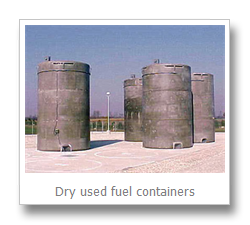
2. The Waste Confidence Rule – In response to a U.S. Court of Appeals for the D.C. Circuit decision that overturned the NRC’s 2010 update to the waste confidence rule, commission staff developed a proposed rule and draft generic environmental study. Published for comment September 13, the proposed rule concludes that used fuel can be safely stored in used fuel pools during the 60-year period following the licensed life for reactor operation and for even longer periods of time in dry containers. The rule also concludes that a repository can be available within 60 years of the end of the licensed life of any reactor to take the used fuel.

The rule answers to the court’s order that the NRC consider the potential environmental consequences of the federal government’s failure to build a permanent repository. The order also required the agency to conduct a more extensive review of the environmental impacts of potential leaks and fires in used fuel storage pools.

The NRC expects to finalize the rule by September 2014. Until then, the agency said it will hold off on issuing final licenses and relicenses for operating reactors and dry cask storage facilities.

3.

The Nuclear Waste Fund fee - The U.S. Court of Appeals for the D.C. Circuit Nuclear Energy ordered the Department of Energy to ask Congress to suspend collection of fees for the Nuclear Waste Fund—which was created to pay for management of the nation’s used nuclear fuel—until the department complies with the Nuclear Waste Policy Act or Congress enacts a new waste management program. The unanimous ruling November 21 reinforces the principle that the federal government is obligated to carry out the law whether or not the responsible agency or the president agrees with the underlying policy.

Congress established the Nuclear Waste Fund expressly to support the development of a repository for used nuclear fuel. Consumers pay one-tenth of a cent per kilowatt-hour of electricity generated with nuclear energy.

---

Next up – the wrap up of the wrap up. Small reactors and cumulative impact of regulation, at the least.

Read More
Posted in atoms for peace, Dwight Eisenhower, Nuclear Energy, nuclear waste fund, waste confidence | No comments

Monday, 30 December 2013

Dropping the Ball

Posted on 12:56 by Unknown

NYE2013ballDon’t make the wrong assumption. This is great:

The Citi Bike Pedal Power Station will be located on the Southeast corner of 7th Avenue and 42nd Street. It will be open to New Yorkers and visitors on Saturday, December 28th and Sunday December 29th from 10:00 AM to 10:00 PM and on Monday, December 30th from 10:00 AM to 8:00 PM. Citi Bike brand ambassadors will be on-site taking photos of participating riders. Participants will receive a free Citi Bike day pass and they will be sent a digital photo of them helping power the Ball that they can save and share via social media.

The six bikes at the Citi Bike Pedal Power Station will be connected to 12-volt deep cycle batteries. Each bike is expected to generate an average of 75 watts per hour. The Times Square New Year's Eve Ball is lit by more than 30,000 LEDs. Throughout the three-day event, a power meter at the Citi Bike Pedal Power Station will show how much energy has been generated.

A lot of this press release is a super hard sell for Citi Bike, so note that. And actually, the New Years Eve ball will not be powered by kinetic energy. What Citi hopes to do instead is return to the grid the amount of electricity necessary to light up and drop the ball. This is in the first paragraph, so nothing untoward here, and it’s a fine goal, even in the name of sales.

The electricity to light the ball will be coming from sources other than kinetic energy – including the Indian Point nuclear facility. Granted, some coal and natural gas will be there, too, doing the electricity thing, but kinetic energy generated by bicycles sounds pretty cool, much cooler in fact. I couldn’t figure out from the coverage here and elsewhere how Citi determined how much electricity the ball will use so as to generate the same amount from their bikes, but really, who cares? The reality is more banal but of the moment – and will create a dazzling illumination – but this is the future.

Read More
Posted in Nuclear Energy Assembly | No comments

The Best Nuclear Energy News of 2013

Posted on 12:31 by Unknown

Your list of the best nuclear news of the year, part 1, and in no particular order. All good news is number 1, right?

1. Pandora’s Promise – There has been a movement by environmentalists to support nuclear energy for some years because of its continued safety record, the inability of renewable energy sources to provide baseload energy and, most especially, the looming spectre of a climate change-driven catastrophe. Robert Stone’s movie Pandora’s Promise made this tectonic shift in attitude manifest for many people. Stone does a lot more than provide talking heads, however, dispelling myths, showing the anti-nuclear movement as driven more by fervor than rationality and facing fully the implications of the Fukushima Daiichi accident.

Still, what a great bunch of talking heads: Gwyneth Cravens, Mark Lynas, Stewart Brand, Richard Rhodes and more. They all articulate their conversions on the road to nuclear energy with great intelligence and humor. For me, Lynas is the breakout star and his visit to Fukushima a highlight of the movie. Theatrically, it’s still working its way around the world, but in the U.S., you can buy it on iTunes if you’re so inclined!

Be sure to check out NNN’s unofficial guide to the movie, an invaluable resource.

2. Yucca Mountain redux – Though President Barack Obama shuttered the Yucca Mountain used fuel repository project in 2009, it never really seemed the last chapter of the story. Yucca Mountain as repository is inscribed into law – The Nuclear Waste Policy Act – and Congressional oversight committees never really bought into any proffered scientific rationale for stopping it. So the fact that the courts are not buying into it either is not surprising – not because its decision clears the way for an inadequate repository but because we can now find out how adequate Yucca Mountain would actually be.

---

The states of Washington and South Carolina, Aiken County, S.C., state public utility regulators and others sought a court order to force the NRC to resume its review of the Department of Energy’s license application for the repository. NEI participated in the suit as a “friend of the court.”

In 2012, the U.S. Court of Appeals for the D.C. Circuit ordered the case held in abeyance to give Congress an opportunity to clarify its intent on funding the program and directed the parties to file status updates during this period. However, the court indicated that, given existing statutory language in the Nuclear Waste Act and the funds available to the NRC—approximately $11 million—it likely would order the license evaluation to continue unless the NRC resumed the process or Congress enacted legislation to either terminate it or clarify that no additional funds should be expended on licensing.

In August, the clock ran out.

“Since we issued that order more than a year ago … the [NRC] has not acted and Congress has not altered the legal landscape,” the court said in its Aug. 13 decision. “As things stand … the [NRC] is simply flouting the law.”

The NRC commissioners directed staff to reactivate the license review process. This does not mean in itself that the repository will pass muster or that Yucca Mountain will become the permanent repository. But it doesn’t mean it won’t, either. Look at it as a simple act of fairness and let the process play out to the end, whatever that may be.

[We’ll talk about the suspension of the nuclear waste fee separately – it’s related, of course, but important on its own account.]

3. New build – Five, count ‘em five, reactors are being built in the United States. Four of them are brand new: two each at Georgia’s Plant Vogtle and South Carolina’s V.C. Summer. The fifth, at Tennessee’s Watts Bar facility, was abandoned in 1985 but will now be completed. The important thing about these reactors in 2013 is that they are maintaining their schedules and budgets effectively, a key point for the industry and its regulator. If construction continues apace – and there’s no reason to believe it won’t – then it will show the effectiveness of the Combined Construction and Operating licensing process and the efficacy with which more generic designs – the Westinghouse AP1000 in the case of the four new reactors – can be erected.

---

Earlier this year, construction at Vogtle reached a milestone when the 900-ton containment vessel bottom head was placed into the cradle in the reactor 3 nuclear island, the heaviest lift at the site to date.

Upcoming work at reactor 3 includes setting the cavity that will house the reactor vessel in the nuclear island.

At reactor 4, nuclear construction is about to begin; the basemat concrete pour will take place soon.

Next steps for construction at the Summer site include setting the first containment vessel ring and the auxiliary building module for reactor 2 and construction of the containment vessel bottom head support module at reactor 3.

Obviously, the real news will be the generation of electricity. Watts Bar should be first in 2015, with the Vogtle and Summer reactors online beginning in 2017. Sometimes, anti-nuclear advocates complain that getting new reactors on line takes too long. But 2015? 2017? They’ll be here before you know it.

Next up (probably): the nuclear waste fee, the waste confidence rule (a lot went on in the used fuel category in 2013) and small reactors. If there are issues you would like to see included, leave a comment.

Read More
Posted in Nuclear Energy, Pandora's Promise, Summer nuclear station, vogtle, Yucca Mountain | No comments

Friday, 20 December 2013

Little Presents: NuScale, Germany, Meateasies

Posted on 12:57 by Unknown

minaturepresentsSustainable Business Oregon presents a interview with Pete Lyons, DOE’s assistant secretary for nuclear energy. It’s fine and worth a read – he talks mostly about the NuScale deal – see posts below for more on this.

Lyons does a good job explaining what NuScale offers specifically and what the interest in small reactors may mean generally:

Small modular reactors offer an opportunity for a new paradigm in how we think about nuclear plant construction. In the past we’ve gone to bigger and bigger plants built at a job site. We have realized there are some economies going to these bigger and bigger plants (built) on site. We’re trying to explore a different type of economy by moving down in size to where they can be built in a factory under factory quality assurance standards and moved intact to a site.

---

The European Union is investigating the deal between the British government and Electricite de France to build a new reactor at Hinkley Point C. That story will require more attention from us when it ripens a bit more. For our current purpose, another EU inquiry is interesting:

The Commission also announced yesterday that it was launching a full investigation into German subsidies for renewables under its renewable energy act (EEG) to determine whether these subsidies constitute illegal state aid. The investigation is looking at the law's exemptions scheme, which makes consumers pay a green surcharge which funds renewable projects, but exempts heavy industry.

“We received various complaints from consumers and competitors on this and the commission must therefore investigate this particular matter in depth,” said Joaquin Almunia, European commissioner for competition.

I’m not sure how many teeth this commission has or how much of the complaining is pure crankery. It does seem as though Germany has really led its people into a financial sinkhole as it tries to move very rapidly from nuclear energy to renewable energy sources.  It also leads to some very un-holiday-like schadenfreude – but we’ll endure it.

---

Some climate change goodness for the vegetarian set:

The analysis also estimates that the greenhouse gas emissions of raising livestock are 19 to 48 times higher than from growing high-protein plant food, such as beans and soy. Last month, a study found that methane emissions in the U.S. were about 1.5 times greater in 2007 and 2008 than previously estimated, and that livestock produced about twice as much methane during that time period than the EPA previously estimated.

The bad news for the vegetarian set is that if the government cannot find a way to grapple with climate change, expecting large swaths of even committed people to abandon meat seems dim indeed. I know from talking with an old 4-H friend that methane mitigation can be done, though still rather theoretically, through feed (see this story from Chemical and Engineering News for more).

The ThinkProgress story suggests that a tax on meat might do the trick, but that’s just silly. Governments like sin taxes because people will pay the tax to maintain their bad habits. But taxing meat as a sin so it becomes prohibitively expensive might well test the elasticity of people’s tolerance for such taxes (meat speakeasies – password “prime rib” – would rise up to feed the protein hungry.) (De)incentivizing behavior through taxation is a tough sell. As we discovered in New York, bans on 32 oz. soda pops to fight obesity doesn’t go over too well, either.

I’d go with the feed idea for now.

---

Happy holidays to our NEI Nuclear Notes friends. We’ve had a great year looking at the interesting, inspiring and sometimes odd happenings in the nuclear energy world during 2013 and reading your views in turn. We look forward to a equally illuminant 2014. Next time out, we’ll start a look at the big stories of the past year. Until then, travel safe and stay reasonably fissionable while hanging around the relatives.

Read More
Posted in Germany, Great Britain, methane, Nuclear Energy | No comments

Wednesday, 18 December 2013

The Renewable Niche and The Nuclear Shrug

Posted on 13:15 by Unknown

Writer Steven Stromberg, writing in the Washington Post Partisan blog, offers this:

Some environmentalists cheer the closing of nuclear plants, even though it makes the anti-carbon effort tougher, and they argue that the country should put all of the planet’s eggs into the renewables basket. The pro-nuclear crowd predicts that a new wave of innovative technologies will make constructing new nuclear plants much more attractive, technically and economically.

The country — and particularly environmentalists — should hope the pro-nuclear side is right; a renaissance in nuclear technology could offer the country a source of reliable, carbon-free electricity with safer designs than those of decades ago, all of which would be particularly helpful if renewables never burst out of their niche end of the market.

The “pro-nuclear crowd'” (I think I prefer mob or cohort) actually includes a fair number of environmentalists.

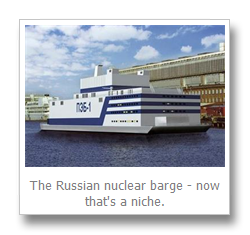
This is a pretty good post, though putting an energy option into the category of niche product is uncomfortable. That’s not quite quite right when referring to renewable energy sources. Floating nuclear barges such as Russia is implementing might be called a niche product because they have carefully defined and fairly limited uses. But that’s not true of nuclear energy itself – or solar or wind power or coal or natural gas. What Stromberg really wonders is if renewable energy sources can gather some market share. Well, so far, they’re like electric cars (which, due to their narrow driving range, might be considered niche projects right now) – the technology is almost there to push their benefits to the fore, but not quite yet. In the meantime, they generate electricity – which isn’t a niche activity.

But where Stromberg is exactly right is that nuclear energy deserves more respect that it often gets:

At the least, utilities, regulators and the public should be open to keeping the nuclear plants the country already has, which represent billions in capital investment, for as long as they can be safely operated. A new report from the American Physical Society finds that many of the plants scheduled for closure in coming years could have another 20 years added to their operating life as long as regulators allow it and maintenance remains vigilant.

I guess you could call this the realpolitik of nuclear energy, that these expensive, long-lived facilities might as well be kept operating because they can do some good. But if you remove the resigned cynicism, it gets to the heart of the issue. Even if Stromberg’s point is that nuclear energy should hang around until renewable energy can do baseload energy, the outcome is that nuclear energy hangs around. Stromberg may encourage environmentalists to shrug their shoulders over this possibility, but it’s okay with me.

---

In the last post, we noted a Forbes takedown of an anti-nuclear energy screed. Now, it indirectly answers Stromberg’s piece with a look at the recent DOE award to NuScale for its small reactor technology.

Think nuclear energy is collapsing? Think again — now that the federal government is ponying up an additional $226 million to help advance small nuclear reactors. The Department of Energy and NuScale are entering a cost-sharing arrangement to build 100-megawatt modules.

Well, nuclear energy was never really collapsing, certainly not if companies such as NuScale can stay in business. But the sentiment is fine.

Not everyone, however, is sold on those small reactors. NuScale has yet to say from where its private funding will come, says Friends of the Earth. It adds that if the idea truly had commercial appeal, it would be able to stand on its own and be able to secure private funding.

It also says that those smaller reactors may produce expensive electricity while at same time, create more radioactive nuclear waste. The “subsidy” is “misguided as these reactors would still produce nuclear waste, still risk meltdown and have not shown to be economical,” says Katherine Fuchs, with the environmental group. “The fact that private investors are not supporting small modular reactors indicates a rather dim financial future.”

We probably could have avoided the Friends of the Earth paragraphs - having FOE in your story is like finding a snail in your birthday cake – but it can be relied on to find the most sour response imaginable to anything involving nuclear energy. Always fun.

Though the story is framed as NuScale bucking downward nuclear trends, writer Ken Silverstein provides an otherwise balanced and interesting take on the NuScale deal. Worth a read.

Read More
Posted in Forbes, Nuclear Energy, Washington Post | No comments

Monday, 16 December 2013

Those Irresponsible Physicians

Posted on 13:44 by Unknown

maddoctormarketstGotta love the title of this Forbes article:

Irresponsible Physicians Oppose Nuclear Energy

It’s a play on the name Physicians for Social Responsibility (the rest of the physicians apparently have a different agenda), which issued a report on energy options. The article (and report, apparently) is more about natural gas than nuclear energy, though author James Conca has nothing but contempt for this idea in the socially responsible physician’s paper:

But the most bizarre section of this report is the attempt to paint enrichment of uranium-235 for fuel as more carbon-emitting than gas. The important CO2 emissions calculation not done by McCullough is that replacing CGS with a gas plant would add over 40 million tons of CO2 to the atmosphere over 17 years. Instead, McCullough’s report [McCullough Research put it together] has a lame discussion of the nuclear fuel cycle and how uranium enrichment at the old weapons-era Paducah plant (no longer operating) is an important emissions source.

Nothing about this report seems remotely interesting, but Conca’s takedown is worth a read, for entertainment value above all.

---

On a sliding scale of actorly achievement, Tom Laughlin (1932-2013) rates much lower than Joan Fontaine or Peter O’Toole. But of the three prominent performers who passed away this weekend, Laughlin wins on sheer entrepreneurial audacity. When his film Billy Jack (1971), which he directed wrote and starred in, got a tepid release from Warner Bros. and tanked, he went to court to reclaim the film, won and re-released it himself by renting out theaters entirely (a method later called four-walling) and barnstorming for an audience. It worked – really well – and the movie became a hit. With its antiestablishment half-Native American antihero protecting an alternative school – it was the early 70s - it held a special appeal to college students. Its sequel, The Trial of Billy Jack (1974), was the biggest hit Warner Bros. had that year (admittedly, a weak year for the studio).

The third film, Billy Jack Goes to Washington (1977), is a remake of Frank Capra’s Mr. Smith Goes to Washington (1939), but replacing the dam that will crush a boy scout camp with a nuclear energy plant that will – well, be a nuclear energy plant. That’s enough to make Billy Jack just want to – go – berserk. (Not on the floor of the Senate, though.)

I wrote about this movie here when it came out on video, so I won’t repeat the daft plot outline or out-of-control pontificating Laughlin indulges in. One can appreciate the sincerity of it all while enjoying a good laugh or concocting a potent drinking game (one shot for every time Billy Jack’s girlfriend Jean dissolves into tears perhaps). It is the least effective anti-nuclear energy movie imaginable, but perhaps worth a look for nuclear advocates – once, anyway.

Laughlin left movies after this, tried politics but mostly lived quietly with wife Delores Taylor, who appears as Jean in all three movies. His web site has been replaced by a memorial – worth a visit for fans. If you’re of a certain age, you may find yourself pausing a moment at Laughlin’s passing – he really only had one moment in his career where he became larger than himself (even if as an unusually violent icon of peace) – and one might have to use that pause to remember who he was – but it’s enough. 

Read More
Posted in Billy Jack, Nuclear Energy, Tom Laughlin | No comments

Friday, 13 December 2013

DOE Awards NuScale Second Small Reactor Grant

Posted on 12:17 by Unknown

Let’s see what’s behind the headline, via the AP:
The U.S. Department of Energy said Thursday that it has awarded an Oregon company a grant to help it design and obtain federal approval for a kind of nuclear power plant - small modular units that can be built in a factory and shipped to installation sites.
That Oregon company is NuScale, a startup company with strong ties to Oregon State University The first DOE award went to the mPower small modular reactor design being developed by long-established Babcock & Wilcox, a company that has been building small reactors for the U.S. Navy for decades. NuScale’s technology approach is unique and allows capacity additions in 45 megawatt increments. In addition, its safety features directly address the lessons learned from the Fukushima Daiichi accident. It’s a pressurized water reactor – as is mPower – with a lot of new ideas regarding safety.
[NuScale offers] a smaller, scalable version of pressurized water reactor technology with natural safety features which enable it to safely shut down and self-cool, with no operator action, no AC or DC power, and no external water. Each NuScale Power Module is 45 MW and has a fully integrated, factory-built containment and reactor pressure vessel.
NuScale lists its attributes:
  • The ability to safely shut down and self-cool, indefinitely, with no operator action, AC or DC power, and no additional water, with NuScale's Triple Crown for nuclear plant safety™ .
  • Seven barriers, between the nuclear fuel and the local community and environment, as compared to three for commercial plants currently in construction and operation.
  • A complete containment and reactor vessel module that can be shipped in segments, by rail, truck, or barge, for quick installation at the plant site.
  • Below grade operating bays for the NuScale Power Modules that are enclosed in an aircraft-impact-resistant seismic Category 1 reactor building.
  • Natural circulation, coolant flow residual heat removal and emergency core cooling systems are powered by natural forces, gravity.
  • A common pool that provides seismic dampening and radiation shielding for the NuScale Power Module.
  • A 60-year plant life
  • A projected capacity factor of >95%
Much of this describes the potential benefits of small reactors in general. But some of it, especially its approach to safety, leverages a patent portfolio NuScale has been building. I asked Paul Genoa, NEI’s senior director for policy development, about this:
“Just to be clear,” Genoa said, “all U.S. nuclear facilities exceed the stringent safety regulations of the Nuclear Regulatory Commission. However, just like the new Westinghouse AP-1000 plants under construction in Georgia and South Carolina, these new small reactor designs being supported by DOE are increasingly using innovative and elegant approaches to ensuring that safety.”
So there you go.
NEI offers a very good description of the implications of the DOE award:
DOE’s selection criteria focused on reactor technologies that have unique and innovative safety features to mitigate the consequences of severe natural events similar to those at Japan’s Fukushima Daiichi. NuScale’s press statement noted that its design’s “unique and proprietary break-through technology” using natural forces of gravity, convection and conduction will allow “safe and simpler operations and safe shutdown.”
And why this is different from the B&W award:
By contrast, DOE’s first solicitation focused on small reactor designs similar to certified large reactors that had the potential to be brought quickly to design certification and licensing. Late last year DOE selected a team consisting of Babcock & Wilcox, Bechtel International and Tennessee Valley Authority to deploy B&W’s 180-megawatt mPower small reactor design by 2022.
You’ll notice the team aspect of the mPower project. That’s true of NuScale, too: it is working with Rolls-Royce (yes, the car people, but they also produce small reactors for the British Navy-see the link), Fluor and Energy Northwest.
More from the AP, with some key dates moving forward:
The company hopes to have the design certified by 2019 and the first commercially operational project working by 2023 at the Idaho National Laboratory in Idaho Falls, Idaho, [NuScale Chief Commercial Officer Michael] McGough said.
This is spectacular news. We’ve been hearing about small reactors for years. Now, here they are.
Read More
Posted in Department of Energy, Fluor, NuScale Power, Rolls-Royce | No comments

Wednesday, 11 December 2013

The End of Megatons to Megawatts

Posted on 13:35 by Unknown

MegatonsToMegawatts-IGThis is what it is – or was:

The Megatons to Megawatts Program is a unique, commercially financed government-industry partnership in which uranium from dismantled Russian nuclear warheads has been recycled to produce fuel for American nuclear power plants.  The 20-year, $8 billion program has been implemented at no cost to taxpayers and is arguably the most successful nuclear disarmament program in history. Virtually the entire U.S. nuclear reactor fleet has used this fuel.

And this has been its benefit:

Since 1995, U.S. utilities have purchased this fuel for their commercial nuclear power plants under Megatons to Megawatts, which has helped fuel approximately 10 percent of the country’s electricity during that time. Nuclear energy facilities received this fuel as part of its commercial fuel contract for low enriched uranium with USEC Inc., the U.S. executive agent for the program.

And now, the Russians have sent the last of the low enriched uranium to the United States. The AP notes it briefly:

The final shipment arrived in Baltimore this week. The shipment was loaded last month from St. Petersburg, Russia. It was the last one under a program known as Megatons to Megawatts. Energy Secretary Ernest Moniz called the program one of the most successful nuclear nonproliferation partnerships ever undertaken.

That’s putting it mildly. You could almost hear the mechanisms of the cold war disassembling.

It could have continued, but the Russians decided to end the program when the agreement expired. There was no particular given reason for this, but Russia has seen an upswing in its nuclear technology exports in recent years and it has explicitly wanted to make more money from the uranium – according to Agence France-Presse, “USEC has signed a new agreement with Russian consortium Techsnabexport, but fuel provided under the deal will be at market prices, USEC said in October.” So, in a way, it is continuing, but as a more commercial enterprise. Still, it’s 20,000 warheads that became megawatts. That’s as good a definition of Atoms for Peace as any, isn’t it?

---

NEI President and CEO Marv Fertel offers his thoughts on the end of Megatons to Megawatts and it legacy on NEI’s YouTube channel. Worth a look.

The great looking infographic used as the illustration above can be found – larger and printable – at the main NEI site.

Read More
Posted in Megatons to Megawatts, Nuclear Energy | No comments

Monday, 9 December 2013

“Nuclear energy is a sector of the future.”

Posted on 13:56 by Unknown

“Nuclear will always make up at least half of our energy (electricity output)," he was quoted as saying during a Franco-Chinese seminar in Beijing on Friday to commemorate a 30-year partnership in the nuclear sector.

"Nuclear energy is a sector of the future," he added.

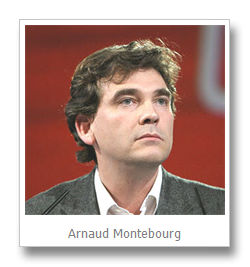
That’s Arnaud Montebourg, the French industry minister, speaking, so he knows whereof he speaks. France is building two nuclear reactors in China, which raises an important point – nuclear energy technology is not just a economic boon to ratepayers like those in France but to companies like the French-owned AREVA, which is building the Chinese reactors.

The Reuters story also mentions in passing that the French utility EDF is building a new reactor in England. This is how trade works.

---

Which may be why we’re hearing this out of Japan:

In an attempt to overturn the previous administration's pledge to phase out nuclear power, Japanese Prime Minister Shinzo Abe's government will call it an "important source of energy for the country" in its new energy plan.

We mentioned last week (in the post below this one) that a government report signaled a return to nuclear energy in Japan. So it does, as this news attests. The Wall Street Journal has more:

Highlighting the economic necessity of nuclear power, the draft points out that a surge in liquefied natural gas imports to stably supply electricity throughout the country has led to very expensive fossil fuels costs. It also said an overreliance on thermal power has increased the country's carbon dioxide emissions.

The story goes on to report that though nuclear energy has not regained its popularity in Japan, Abe remains quite popular despite these decisions. Polls are polls and can carry a lot of unintended implications, but let’s allow that Abe’s good standing may carry nuclear energy along with it as electricity prices drop and carbon emissions relent. 

Nothing here about trade, really, but Japan does consider nuclear technology an exportable good. I can’t help thinking that that may be playing a part in Abe’s calculations.

Read More
Posted in AREVA, EDF, France, Japan, Nuclear Energy | No comments

Friday, 6 December 2013

Japan: The strongest signal yet on nuclear energy

Posted on 13:47 by Unknown

News from Japan:

Japan should continue to use nuclear power as a key energy source despite the Fukushima power plant disaster, a government panel said on Friday in a reversal of a phase-out plan by the previous government.

Given the turn over in Japanese governments, policy reversals could go on forever, but the recommendation is sound. That doesn’t mean that there will not be significant pushback, though.

The primary example remains the former, much respected, prime minister, Junichiro Koizumi, who has really gone on a tear against nuclear energy:

In a speech Nov. 12 at the Japan National Press Club in Tokyo, Koizumi said, “I think it will be good (for Japan) to end (nuclear power generation) immediately.”

It was a brutally clear message from the mouth of a person who had long been at the center of political power.

And though he faced a lot of criticism for taking this stand (he was for nuclear energy as PM), his words carry real weight with the public:

In an opinion poll conducted by The Asahi Shimbun last weekend, 60 percent of the respondents agreed with Koizumi. Among the supporters of the ruling Liberal Democratic Party [also Koizumi’s party], 58 percent agreed.

Polls being polls, it can be parsed any number of ways, but Koizumi’s influence can be little doubted. 

Which doesn’t mean the recommendation is not good news. It is. Very good news.

Business Week explains why:

Energy costs also are a concern for the government. Power prices in Japan are more than twice those in the U.S. Electricity for industry use costs an average 17.9 cents per kilowatt-hour in Japan compared with 7 cents per kilowatt-hour in the U.S., 12.7 cents per kilowatt-hour in the U.K., and 12.2 cents per kilowatt-hour in France, according to an energy ministry research paper citing 2011 figures.

And:

The alternatives to nuclear power either pollute more or come with a higher fuel cost, limiting Abe’s scope to reshape the energy industry and boost economic growth. Coal use rose 26 percent from a year ago in October. While solar power is taking off, the added capacity is nowhere near replacing what traditional plants supply.

Whatever Japan decided about nuclear energy has always been up to Japan. Whatever arguments could be arrayed to show that it remains the best solution to Japan’s social, economic and energy goals cannot trump the country’s experience after Fukushima Daiichi and the fantastically destructive earthquake and tsunami that precipitated the accident. That’s a national trauma outsiders cannot gainsay. 

And now we need not. Because Japan is close to returning to nuclear energy – current Prime Minister Shinzo Abe will need to issue a policy statement – but as Business Week writes, “this is the strongest signal yet that it wishes to keep nuclear energy.”

Read More
Posted in Fukushima Daiichi, Japan, Nuclear Energy | No comments

Wednesday, 4 December 2013

World Bank Toff: “We don’t do nuclear energy.”

Posted on 14:16 by Unknown

So says World Bank President Jim Yong Kim:

“We don’t do nuclear energy.”

Okay.

“The World Bank Group does not engage in providing support for nuclear power. We think that this is an extremely difficult conversation that every country is continuing to have.

“And because we are really not in that business our focus is on finding ways of working in hydro electric power, in geo-thermal, in solar, in wind,” he said.

“We are really focusing on increasing investment in those modalities and we don’t do nuclear energy.”

But the story from Agence France-Presse also includes this tidbit:

In some countries, only 10% of the population has electricity.

Hope there are enough rivers to dam in those places.

---

From Scotland:

New nuclear would not play a role in an independent Scotland, according to a white paper published by the Scottish government in November.

The current Scottish government is opposed to the building of any new nuclear power stations in Scotland and will phase out existing stations in Scotland over time, it said.

Scots independence could happen – a referendum is scheduled for 2014 and Scotland would become a new nation in 2016 if the vote is successful – but polling tends to be rather dim on the prospect. See here for more.

So, absent nuclear energy, what then?

The Scottish Government aims to generate the equivalent of 100% of electricity from renewables and thermal sources fitted with carbon capture and storage by 2020.

Yup, that’ll boil the haggis.

---

Boy, some days you wake up and no one likes you. Let’s leave it to John Parker, resident of Falmouth Maine, to make the case:

So, if you are one of the fanatics, I urge you to reconsider the issue [of nuclear energy] in a rational manner. We should all promote the only source of power that has no environmental impact and will have enough capacity to start closing down carbon-burning plants. We have many years of total success, our technology and know-how have come a long way since the construction of Three Mile Island, and the blatant errors in Ukraine and Japan can easily be avoided.

Parker makes some overly broad assumptions, but his rough-and-ready defense is a real tonic. Props to the Portland Press-Herald for not polishing his comments into blandness.

Read More
Posted in Maine, Nuclear Energy, Scotland, World Bank | No comments

Monday, 2 December 2013

Recontextualizing the Nuclear Option

Posted on 12:56 by Unknown

newyorker_logoWhen the Senate changed the filibuster rules to allow judicial and executive appointments to proceed to the floor with 51 votes instead of the 60 the filibuster required, the process was called the nuclear option, a name given it (probably) by Sen. Trent Lott (R-Miss.) back in 2006. The association has always been with weaponry not energy, but the New Yorker’s Hendrik Hertzberg goes with energy – in a notably detailed metaphor – and in notably familiar language:

But global warming has changed the picture. Nuclear power isn’t the best way to reduce carbon emissions—that would be wind and solar. For the intermediate future, though, breezes and rays won’t be enough. As growing numbers of environmentalists and climate scientists have come to realize, nuclear power is much, much better than what remains the real-world alternative: fossil fuels like oil and, especially, coal. When it comes to energy, the nuclear option, though not the best of all possible worlds, is better than the one we’re living in.

In Hertzberg’s view, exercising the nuclear option in politics or energy policy is the equivalent of doing the next best thing given the status quo.

There’s a larger point, too, to focus on the experiential nature of political or energy choices. One knows that a simple majority in the Senate might reduce the backlog of appointments. One knows that nuclear energy is carbon emission free and scalable. Hertzberg carries his metaphor no further than that - the quote above is all there is to it. He doesn’t really describe, for example, what the wind and solar energy options for filibuster reform would be – he seems in favor of fully ending the filibuster, even for legislation, so perhaps that’s it.

---

The way Hertzberg phrases his support is interesting, too. Take this bit from the open letter recently released by four prominent environmentalists:

Renewables like wind and solar and biomass will certainly play roles in a future energy economy, but those energy sources cannot scale up fast enough to deliver cheap and reliable power at the scale the global economy requires. While it may be theoretically possible to stabilize the climate without nuclear power, in the real world there is no credible path to climate stabilization that does not include a substantial role for nuclear power.

We wrote much more about this important missive here and had an eye out for pickup in the press – we rounded up some of that here – but Hertzberg does not reference it. It’s just in the wind, being lit by the sun. Hertzberg has his mind on a different topic entirely, but I wonder whether his matter-of-fact endorsement was influenced by the letter. 

As for the filibuster rule change, early days. For climate change, getting later every minute. And for the nuclear option? Thanks to Hertzberg, it has a much better metaphorical future.

Read More
Posted in Nuclear Energy, nuclear option, The New Yorker | No comments

Friday, 22 November 2013

Maybe Yes Maybe No for Nuclear Energy in Bolivia

Posted on 12:30 by Unknown

Add another country to the growing list of those who know there’s something to this nuclear energy thing:

Bolivia is on track to develop a national nuclear power program for peaceful civilian purposes that include building electricity export capacity in the country, official media reported.

According to the UPI story, this has been percolating since last month, when Bolivian President Evo Morales reactivated a long-delayed nuclear energy program.

This has proven mildly controversial because Morales has had fractious relations with the United States – the countries booted out each other’s ambassadors in 2008 - though the relationship has improved in recent years.

Whether Bolivia can field a nuclear energy program is guesswork at this time. Bolivia is a relatively small country – with about 10.5 million in population – and poverty alleviation is a priority for the Morales government. While the country might be a prime candidate for clean-energy industrialization, there is a lot of stress on resources – the government recently tried to scale back on commodities subsidies but had to relent after protests.

And, of course, talking isn’t doing, which leads to reservations:

Morales told an energy conference in Tarija, southern Bolivia, in October the country has achieved conditions necessary to obtain nuclear power for "pacific ends," Los Tiempos reported. Morales did not elaborate, nor did he offer details when he announced Argentina and France would help Bolivia attain nuclear power generation capacity.

So, as always, we’ll see.

---

There’s nothing for us to say about the recently-activated nuclear option. But it has led to some great headlines:

Senate Goes for Nuclear Option

Senate Democrats Go Nuclear

Going Nuclear

Forced to Go Nuclear at Last

I’ve cheated on a few of these and, of course, some headline writers went for nuclear war analogies – fallout, launched, etc. But the overall consensus settled on “going nuclear.” And we have no problem with that at all. You say it’s all about the fili – what? Sometimes, ignorance can be bliss.

Read More
Posted in Bolivia, Nuclear Energy | No comments

Wednesday, 20 November 2013

Absent a Repository, Nuclear Waste Fee Suspended

Posted on 12:51 by Unknown

The nuclear waste fee, established by the Nuclear Waste Policy Act of 1982, pays for the building of a permanent repository for used nuclear fuel. When the government settled on Nevada’s Yucca Mountain for the repository site, Congress in 1987 amended the act to include it.

All that made sense – the industry paid for a repository and the government would take charge of used fuel and put it there. But when President Barack Obama ended the Yucca Mountain project in 2009 with no alternative site envisioned, numerous unresolved problems developed: first, the law stipulates Yucca Mountain and no place else as the repository. And second, how much money should the industry’s ratepayers pay into the nuclear waste fund without an actual repository to fund. Is $29 billion enough? Because that’s how much has been collected. Should the industry keep paying about $750 million per year when the government has no designated repository site to spend it on.

The U.S. Court of Appeals in Washington ruled that the Energy Department must take steps to suspend collection of the nuclear-waste fee from utilities because the government has provided no alternative to a canceled project at Yucca Mountain in Nevada, for which the funds are collected.

The three-judge panel said the Energy Department failed to come up with an adequate evaluation for the waste fee, which is paid into a fund that has grown to more than $29 billion since the first money was collected in 1983.

Because how do you evaluate it when the repository itself is vapor?

The agency’s assessment of disposal costs was “so large as to be absolutely useless to be used as an analytic technique,” Circuit Judge Laurence Silberman wrote in the seven-page decision. He said the department’s presentation reminded the court of a line from the musical “Chicago,” which says, “Give them the old razzle dazzle.” 

This is from Bloomberg’s Brian Wingfield and Andrew Zajac. Matt Wald a the New York Times adds more context.

In a decision written by Judge Laurence H. Silberman, the court ruled that “until the department comes to some conclusion as to how nuclear wastes are to be deposited permanently, it seems quite unfair to force petitioners to pay fees for a hypothetical option.” What they have already paid might cover that cost, Judge Silberman wrote, adding, “the government apparently has no idea.”

That’s on the button. That’s the issue and Judge Silberman makes of it a simple question of fairness – well, not only fairness, of course, but that is key to the industry’s position. You can read the whole decision here. It was fair to contribute when there was a repository and will be again when there is a designated site, but now?

---

Wald points out that this dovetails with another court decision that has implications for the used fuel repository:

There is in fact no assurance that Yucca would turn out to be suitable. The Energy Department applied to the Nuclear Regulatory Commission for a license to build and operate the repository, but then tried to withdraw the application, and the commission stopped work. This year, the appeals court ordered the commission to resume work on the license, and on Monday, the commission said it would do so until it had exhausted the money it had on hand for that purpose, about $11 million.

It’s taken awhile, but the consequences of stopping Yucca Mountain – and continuing the fee – and ending the NRC’s assessment of the site – has become considerably clearer. And Congress, which passed the act and now could amend it to cover current circumstances?

The decision increases pressure on Congress to act, but on this issue, as on others, it is deadlocked. House Republicans want Mr. Obama to follow the laws passed in the 1980s and develop Yucca. Harry Reid, the Nevada Democrat who is the Senate majority leader, has blocked funding.

And so it goes. Some bipartisan movement has occurred on the issue and the court decision could spur further developments. In any event, a lot of the news lately on these issues have been good – and when the news about this is good, it’s good not just for the industry, but especially for electricity consumers.

---

NEI’s General Counsel Ellen Ginsberg issued this statement on the nuclear waste fee decision:

“Today’s decision confirms that the federal government cannot continue to defy Congress’ explicit direction to implement a viable program to manage reactor fuel from America’s nuclear power plants. The court’s ruling reinforces the fundamental principle that the federal government’s obligation is to carry out the law, whether or not the responsible agency or even the president agrees with the underlying policy.

“We agree with the court that unless and until the Energy Department’s repository program is restarted or another waste disposal program is developed, it is appropriate that the Nuclear Waste Fund fee be suspended.

“The court’s decision should prompt Congress to reform the government’s nuclear waste disposal program. We strongly encourage Congress to establish a new waste management entity, and endow it with the powers and funding necessary to achieve the goals originally established in the Nuclear Waste Policy Act. We look forward to working with Congress as members develop legislative proposals to remedy the currently untenable situation.”

Read More
Posted in Nuclear Energy, nuclear waste fund, Nuclear Waste Policy Act, Yucca Mountain | No comments

Monday, 18 November 2013

The Distraction of Coal at COP19

Posted on 14:32 by Unknown

The Warsaw COP19 climate change negotiations experienced a bit of local competition that proved to be pretty interesting itself: the International Coal and Climate Summit, held at Poland’s Ministry of Economy.

Here’s the description:

International Coal & Climate Summit will bring together the leadership of the world’s largest coal producing companies, energy & heat producers, coal-consuming industry representatives, senior policy-makers, academics and NGO representatives to discuss the role of coal in the global economy, in the context of the climate change agenda. The industry’s most important event this year will be held at the Ministry of Economy of Poland during climate change negotiations.

The keynote address, delivered by Christiana Figueres, Executive Secretary for United Nations Framework Convention on Climate Change, is notably stark and to the point:

Development banks have stopped funding unabated coal. Commercial financial institutions are analyzing the implications of unburnable carbon for their investment strategies. Pricing of GHG [greenhouse gas] emissions is on the rise, evidenced by trading markets coming online around the globe. And, international policy is moving us toward a global low-emission economy.

Her prescription for the industry, also quite stark:

Close all existing subcritical plants; Implement safe CCUS [carbon capture use and storage] on all new plants, even the most efficient; and Leave most existing reserves in the ground.

But this is why coal industry figures are there. This is what they want to hear. Whatever their individual views, they take what Figueres has to say quite seriously – and she clearly takes their capacity for change and technology wherewithal equally seriously.

These are not marginal or trivial changes, these are transformations that go to the core of the coal industry, and many will say it simply cannot be done. But the phrase “where there’s a will, there’s a way” is tantamount to human history because will precedes innovation, and innovation precedes transformation.

John F. Kennedy called for putting man on the moon in ten years at a point when no one knew how that would be done.

We must transform coal with the same determination, the same perseverance, the same will. We must be confident that if we set an ambitious course to low-emissions, science and technology will rapidly transform systems.

Above all, you must invest in this potential, because the coal industry has the most to gain by leveraging the existing capital, knowledge and capacity to transform itself.

This is one of the most striking speeches on energy industry challenges I’ve heard – and, correctly, it is guardedly but decidedly optimistic. Even if it’s not about nuclear energy, the whole thing is worth a read.

---

The New York Times has good coverage of the speech. This bit stuck out in the coverage:

Environmentalists criticized the very existence of the coal summit. Alden Meyer, director of strategy and policy at the Union of Concerned Scientists, an American advocacy group, called the summit “a distraction.”

A distraction – or a key topic in the larger discussion? That’s clearly how Figueres views it. We should have more such distractions.

Read More
Posted in climate change, coal, Nuclear Energy | No comments

Friday, 15 November 2013

The Irrational Now and the Catastrophic Later: Nuclear Energy in a Time of Climate Change

Posted on 11:39 by Unknown

Nathan Myhrvold, the former Microsoft technology office and current venture capitalist with a position on the board of nuclear energy startup Terrapower (whew!), makes the case:

Nuclear technology is scary to some people because they fear extremely improbable scenarios while ignoring the virtual certainty of climate issues. Ironically people who argue against nuclear on environmental grounds may contribute to a far greater environmental catastrophe. Unfortunately the physics of climate change makes the here and now danger too easy to ignore.

He goes on to explain that the worst impacts of climate change will happen over the course of the 21st century and beyond. He doesn’t say it, but that means many of us won’t be around to experience it and what Myhrvold implies – well, let’s let him say it:

This means that if we wait until temperature change becomes an obvious and immediate problem, we’ll only be half way through the warming caused by carbon dioxide that is already in the atmosphere. Even radical cutbacks at that point will not prevent another century of warming.

Obviously, Myhrvold is interested in nuclear energy as a means to combat climate change, but his implicative connection between what people irrationally fear now from nuclear energy and what they will not have to fear from the slow moving disaster of climate change is unique and has some explanatory power. I think Myhrvold underestimates concerns for the fate of humanity’s children and grandchildren, still, this strikes a chord.

---

Myhrvold’s piece is part of the New York Times’ Room for Debate series, which is currently exploring the letter from four top environmentalist requesting the increased use of nuclear energy to combat climate change. Naturally, being a debate – sort of - some of the writers take a dimmer view of nuclear energy than others, but none dismiss it out of hand. Here’s Harvard historian Naomi Oreskes, whose latest book looks witheringly upon the wedding in black of politics and industry with (some) scientists:

In their new book, Merchants of Doubt, historians Naomi Oreskes and Erik Conway explain how a loose–knit group of high-level scientists, with extensive political connections, ran effective campaigns to mislead the public and deny well-established scientific knowledge over four decades.

The book discusses tobacco and DDT in this context and also climate change. Nothing startlingly new in the ongoing study into the human capacity for corruption, but sobering when all put between two covers. Anyway:

And that’s the point: nuclear power has never delivered on its promises. It hasn’t been the miracle technology that its advocates envisioned back in the 1950s, and it remains one of our most expensive sources of electricity. Citizen opposition explains very little of its high cost, most of which arose from difficulties inherent to the technology and its management.

The first bit (“miracle technology”) means that advocates in the 50s may have yoked the batter a bit, but domestic nuclear energy has certainly delivered on its promise – and expensive source of electricity is not one of them. Ask Japan – or Germany.

This is her proposal:

Several commentators, myself included, have argued for a new Manhattan Project on energy and the environment to develop options. This could include safer reactors, but also carbon capture and sequestration, improved efficiency and storage for renewable sources, better building design, and smart electricity grids, as well as regulatory and taxation structures that foster innovation and public acceptance.

Well, the Manhattan Project operated in secret and didn’t have competing goals. But this is Oreskes’ reason for the comparison:

The approach taken [in the Manhattan Project] was not to decide in advance which technological approach was most likely to succeed, but to try them all. It was an expensive strategy, but it worked. This is what we need to do now.

It is called Room for Debate, after all, and I certainly find Oreskes’ ideas debatable on multiple levels – and really tough to make work across many multiple disciplines. But not invalid perforce.

---

There are two other worthy participants. Mark Lynas, the environmental activist who featured very appealingly in Pandora’s Promise , thinks nuclear has to be part of the mix along with renewable energy, and Zhao Zhong from Pacific Environment goes for a carbon tax. All worth a look.

Read More
Posted in Naomi Oreskes, Nathan Myhrvold, New York Times, Nuclear Energy | No comments

Wednesday, 13 November 2013

The Right Context for Nuclear Energy

Posted on 14:15 by Unknown

BeautyshotSometimes, we run into statements about nuclear energy that do not really cry out to be said. It’s not that any number of things, many quite trivial, don’t get said in the course of a given day, it’s that a little more thought might warn one away from speaking. For example:

“Sometimes it does but it’s a tricky thing to determine that concept [probably means context]. We can find many instances in which parties have tried to implement nuclear power in the wrong context, which leads to high costs and exposes populations to a greater risk of accident so it’s important to find the right context for nuclear energy.”

Okay, I guess, if awfully presumptuous. Let’s start with this and see where it goes.

“Nuclear energy has some specific requirements,” he said. “In Bolivia, which is a landlocked nation where it’s relatively arid so there’s no water cooling, it would be very difficult. In some cases, it’s a geographically imposed context. In others, it’s the size, or if a country has bad credit, because nuclear energy is very expensive.”

Wait, what? Bolivia isn’t looking to open a nuclear energy facility – and why would a country with bad credit – unless maybe it’s a home-grown industry – wait a minute - what?

All this was said by David Scott, executive director of economic and energy affairs at the Abu Dhabi Executive Affairs Authority. I’ve nothing against Mr. Scott, of course, but what is he talking about?

“It’s possible to put a plant in a location where it maybe doesn’t belong,” he said. “The accident in Fukushima is an example of that, where the design of the plant they deployed was not appropriate for the natural challenges of that site, so context is very important.”

Yet Fukushima Daini (and Onagawa, too), which was hit by the same earthquake and tsunami that crippled Fukushima Daiichi, rode out the natural assault. (Daiichi means number one, Daini number two – the facilities are neighbors.) And of course, Japan doesn’t have one facility, as Bolivia ill-advisedly would. Scott is being fantastically reductive here, constructing a dubious premise to accommodate a single instance – and the instance doesn’t really fit the premise – which is dubious, anyway. And so on.

Well, the conference at which he said this wasn’t a total loss.

Kristine Svinicki, a member of the US Nuclear Regulatory Commission, said the challenge of meeting rising demand, while balancing cost, safety, security and environmental protection, was leading many countries to consider deploying new nuclear power plants.

“But unlike safety, risk assessment for security does not generally involve a known set of verifiable scientific and engineering parameters,” she said. “So it is often a challenge to strike the necessary regulatory balance. But safety and security take priority over all other considerations.”

Sounds a bit like an amused response to Scott, doesn’t it? In any event, props to Commissioner Svinicki for an interesting take on risk assessment.

Read More
Posted in Nuclear Energy | No comments

Tuesday, 12 November 2013

“I think nuclear will have to be an option.”

Posted on 13:48 by Unknown

Southern Co. has not had a bad time putting up two new reactors at its Plant Vogtle site in Georgia, so maybe they can do a little more of that (behind a pay wall, though you can join for the day for 99 cents – though your email will never see the end of solicitations):

The company — convinced natural gas and alternative fuels will not satisfy future demand — is already considering whether to start the process toward another, post-Vogtle nuclear project, a top executive says.

“I can tell you that we want to keep nuclear as an option on the table, so don’t be surprised if we start a licensing process to keep that option alive,” President and Chief Executive Officer Paul Bowers said in an interview with the Atlanta Journal-Constitution. “(It’s) a 10-year, 10-to 12-year process to build. So keeping it alive, I think we have to keep that in consideration.”

Bowers says the idea would be to consider new build after determining Georgia’s electricity needs in 2025. But what about renewables. Meet the knights who say Niche:

The falling cost of solar makes it a more viable resource, but the utility and its parent, Atlanta-based Southern Co., say renewables will remain a “niche” in the Southeast for now.
“If you’re going to take coal out of the mix, then you’re left with two options for diversity: that’s nuclear and natural gas,” said Chuck Eaton, chairman of the Georgia Public Service Commission. “We’re expecting the economy to get better … there will be more demand on the grid, (so) I think nuclear will have to be an option.”

Kristi Swartz’s story does not expand on why Southern Co. considers renewables a niche, but Southern Co. Chairman, President and CEO Thomas Fanning certainly has done so:

Fanning said renewable sources of energy like wind and solar tend to be available in sparsely populated areas, requiring expensive transmission lines to distribute the electricity.

Renewables rely heavily on federal tax credits, making the industry vulnerable if those go away, he said.

Fanning said renewable energy also is intermittent by nature.

“What do you do when the wind doesn’t blow and the sun doesn’t shine?” he said.

He does say, though, that renewable energy could become more economical – or more stably economic - over the next decade and, then, maybe. And it looks like Southern Co. and Georgia Power are pacted with Ted Turner on some renewable projects, so there’s that.

Read More
Posted in Nuclear Energy, Southern Company, vogtle | No comments

Thursday, 7 November 2013

Born Among Goats: Nuclear Energy and the Liberal Project

Posted on 13:00 by Unknown

CNN has been soliciting a lot of op-ed style pieces to promote its showing of Pandora’s Promise. As Eric points out in the post below, CNN has really done a good job gathering this material, though both pro- and anti-nuclear energy advocates often use their space to make clear their talking points, assuming – probably correctly – that many people have not been engaged in their somewhat internecine arguments.

Still, Rachel Pritzker, president of the Pritzker Innovation Fund, tries an interesting approach.

It is time for policymakers to recognize that nuclear power must be a robust part of our nation's energy plan to reduce carbon emissions.

These may seem like strange words coming from a liberal whose family has been active in progressive politics, and who grew up on a Wisconsin goat farm in a home heated by wood fires. Like many of my fellow progressives, I care deeply about the environment and the future of our planet, which is precisely why I do not think we should be reflexively shutting the door on a technology that may be able to help address global climate change.

I’m not entirely sure why living on a goat farm with wood-burning stoves – not a very environmentally friendly energy source – wins liberal credit, but I guess it has to do with the Whole Earth Catalog strain of 70s thinking (founded, by the way, by Pandora’s Promise’s Stewart Brand.) That’s fine. How one gets from that to nuclear energy, though, is the interesting part.

Pritzker writes that her travels to Latin American have shown her that people there are eager to develop more energy options to improve their economic standing. In order to feed this need, governments (and utilities) will need to find ways to implement scalable energy sources that do not produce greenhouse gasses. Enter nuclear energy.

If we are going to address climate change and help the global poor live longer, healthier lives, then, we need to begin a vigorous public discussion about other low-carbon energy options that are quickly scalable - including nuclear power.

There is a kind of liberal thinking here that equates those not living at middle class industrialized levels as poor. It’s more complex than that, as there are more ways to live happy lives than one. On a goat farm with wood burning stoves, for example. But on points, she’s exactly right.

Pritzker proves exceptionally open-minded in clearing away the ideological cruft:

After the failures of cap and trade and the United Nations climate treaty, nuclear energy could be a place where left and right find common ground on energy. Only if we are willing to reexamine our previous assumptions, and open up new spaces for dialogue, will we have any chance of addressing our nation's many complex challenges.

To be honest, I don’t think nuclear energy – or any energy source – benefits from being associated with ideology. It’s a wrench in the policy tool chest to accomplish a societal – in this case, a global – goal. But my thinking that does not mean Pritzker thinks it, so her inviting nuclear energy to the communal energy table must be a jump – a jump away from ideology.

And even better, it’s for extra-ideological reasons. Many environmentalists – and I’d count most of those featured in Pandora’s Promise – probably consider themselves very liberal indeed – even radically so – but find nuclear energy solves one of their most pressing policy goals. Not just helps it, but potentially solves the biggest problem energy policy means to address in the teens. It’s unlikely to get that chance – too many competing factors – but it could do it.

Let’s consider it all the final fade of the No Nukes era, which attracted much liberal support in the 80s. Nuclear energy isn’t a partisan issue. Yet, it doesn’t matter that it’s taken some folks born-among-goats a while to realize it; it only really matters that they do realize it.

Read More
Posted in No Nukes, Nuclear Energy, Pandora's Promise | No comments

With Pandora's Promise in Hand, CNN Shining Light on Politics of Yucca Mountain

Posted on 08:05 by Unknown
I'm a Washington policy professional but also a Washington native, and so over the better part of four decades I've developed a distinct appreciation for how policy in this city is covered by the fourth estate. To cut to the chase: I'm pretty much underwhelmed/infuriated by a wide swath of the Washington press corps on pretty much a daily basis. But not today.

For the better part of the past month I've worked closely and in most rewarding fashion with the producer-reporter tandem of David Fitzpatrick and Drew Griffin of CNN. Tonight of course that outlet is airing the magnificent documentary 'Pandora's Promise.' In support of the documentary CNN has devoted extraordinary resources this fall to informing the public about nuclear energy. In sprawling digital and broadcast news and commentary this week, CNN has covered nuclear's voices pro and con, academic and activist, political and wonkish. Nuclear power in the United States has known both triumph and struggle in recent years, and it's all well detailed in CNN's reporting this week. As a result, the American public knows more about our technology and about our nation's energy policy.

A number of CNN reporters have weighed in on nuclear energy this week, but David and Drew especially have traveled the country to visit our sites, talk to our engineers and executives, and richly record the workings of our industry. They even ventured into places far more frightening and dangerous than any nuclear plant: the offices of Washington lawmakers. It's been good old fashioned gumshoe journalism emanating out of Atlanta, and for me it's been a powerful reminder of what journalism once was and seldom is any more.  

Within CNN's extraordinary coverage breadth this week there have been treatments I've positively cheered, while in other instances I've frowned and sighed as the outlet gave air time and bandwidth to tired and outdated anti-nuclear sentiments. In other words, they've struck a pretty fair balance in their coverage of a contentious topic. I don't often get to make such a claim about the reportage my media manager colleagues and I try and help shape.

I'm most particularly struck by CNN's report on Yucca Mountain. Instead of the usual ping pong-partisan back and forth we see all too often in policy coverage, CNN's reporting on the failed Nevada project focuses, in fair and unsparing fashion, on the dogged obstructionist efforts of Senate Majority Leader Harry Reid and his former henchman at the NRC, Greg Jaczko. Of the former NRC chairman CNN said, "You might call him Yucca Mountain's hired killer." [Emphasis mine] Watch it below ...


The American public, I submit, has a right to know who specifically ought to be held accountable for the waste of $10 billion in taxpayer dollars associated with the termination of the repository project. In this report we get straight-talk to that.      

     
Read More
Posted in CNN, David Fitzpatrick, Drew Griffin, Gregory Jaczko, nuclear waste, nuclear waste fund, Nuclear Waste Policy Act, Pandora's Promise, Senator Harry Reid, used nuclear fuel, Yucca Mountain | No comments
Newer Posts Older Posts Home
Subscribe to: Comments (Atom)

Popular Posts

  • More of The Best Nuclear Energy News of 2013
    1. The 60th anniversary of Atoms for Peace (and NEI, too) – President Dwight Eisenhower gave the Atoms for Peace speech before the Unite...
  • Shift in Clinton Plant Refueling Cycle Increases Efficiency
    NEI’s Top Industry Practice Awards recognize innovation in the nuclear energy industry. Presented at NEI’s annual conference, the awards h...
  • A Man, A Plan, A Canal–Panama! – Oh, and A Floating Reactor, Too
    Floating nuclear energy stations, highlighted by the Russian effort noted below, are not a new phenomenon and represent a further develo...
  • Nuclear Fusion and Imploding Porcupines
    When the sun makes energy through nuclear fusion, it has the benefit of not having to pay real cash for the energy expended to make more...
  • Nuclear Debate at the Daily Show
    Yesterday, Bloomberg News wrote a story on NEI’s ad campaign and highlighted one TV spot that will air on, among other programs, Comedy Ce...
  • Going to Mars – and Quickly – With Nuclear Energy
    The White House ’s petition site, called We the People , has gained some attention over the last couple of months because – well, let’s just...
  • America’s STEM Crisis Is No Conspiracy Theory
    I can attest that the STEM crisis is real and is causing challenges for the nuclear energy industry. My experiences contradict the conclusi...
  • Energy Plants: An Open and Closed Case
    Oregon's Boardman Coal Plant Our friends over at Coal Power have done a real service, taking a look at energy generation plants set to c...
  • Patrick Moore’s Economic Justice
    Patrick Moore, ex-Greenpeace, sees in nuclear energy an interesting argument for what he terms “environmental justice,” which is true enough...
  • Song of SONGS: The Moral Dimension of Nuclear Energy
    The San Diego Union-Tribune offers an exceptionally interesting op-ed on the closing of San Onofre (which is about midway between San ...

Categories

  • #CNOSummit
  • 123 agreement
  • 2012 Elections
  • 2012 India Blackout
  • 2012 Nuclear Energy Assembly
  • 2013 Nuclear Energy Assembly
  • 2013 State of the Union
  • 316b
  • 60th Anniversary
  • 9-11
  • ABC
  • Advanced Research Projects Agency
  • advertising
  • Africa
  • Agreement States
  • aircraft impact
  • Al Gore
  • Alabama
  • Alan J. Kuperman
  • Albania
  • Alec Baldwin
  • Alex Flint
  • Allison Macfarlane
  • Amber Lyon
  • Amber Lyons
  • Ameren Missouri
  • American Electric Power
  • American Power Act
  • American Wind Energy Association
  • Andrew Revkin
  • Anil Kadkodkar
  • Ann Bisconti
  • AP1000
  • Apple
  • AREVA
  • argonne national lab
  • Arizona Public Service
  • Arizona Strip
  • Arkansas Nuclear One
  • Arnie Gundersen
  • Associated
  • Associated Press
  • Atomic Industrial Forum
  • atoms for peace
  • Australia
  • Babcock and Wilcox
  • Bangladesh
  • Barack Obama
  • Barclays
  • baseload
  • battery 500
  • Belgium
  • Berlin
  • Bezdek
  • Bhopal
  • Bill Gates
  • Billie Garde
  • Billy Jack
  • Bisconti
  • Blogging
  • Blue Castle
  • blue fin tuna
  • Blue Ribbon Commission
  • bluefin tuna
  • Bob Bishop
  • Bolivia
  • Breakthrough Institute
  • BREDL
  • Britain
  • Brown's Ferry
  • Browns Ferry
  • Bulgaria
  • butterflies
  • California
  • California Energy Commission
  • Callaway
  • Calvert Cliffs
  • Canada
  • cancer
  • Cape Cod Times
  • Carbon Emissions
  • carbon tax
  • Caroline Cochran
  • CASEnergy Coalition
  • Center for Advanced Energy Research
  • cesium
  • Charles Till
  • Charlotte
  • China
  • Chip Pardee
  • Chris Crane
  • Clean Energy
  • clean energy standard
  • climate change
  • Clinton Nuclear Power Station
  • Cloud Atlas
  • CNN
  • coal
  • cold fusion
  • Columbia Journalism Review
  • common language
  • Congress
  • Constellation Energy
  • cooling tower
  • cost recovery
  • crocodiles
  • Crystal River
  • CSIS
  • Curio
  • Curiosity
  • CWIP
  • Cyber Security
  • Czech Republic
  • D.C. Cook
  • Daily Kos
  • Daily Show
  • Dale Klein
  • Dan Lipman
  • data centers
  • David Allard
  • David Fitzpatrick
  • David Lochbaum
  • debate
  • defense
  • Denmark
  • Department of Atomic Energy (India)
  • Department of Energy
  • Department of Homeland Security
  • Department of the Interior
  • Design Basis Threat
  • Diego Garcia
  • Dominion
  • Dominion Resources
  • Dominion Virginia Power
  • Dr. Patrick Moore
  • Dr. Robert Peter Gale
  • Drew Griffin
  • Duane Arnold
  • Duke Energy
  • Dwight Eisenhower
  • Earth Day
  • earthquake
  • East Coast Earthquake
  • economic benefits
  • Ed Halpin
  • EDF
  • Edison
  • education
  • efficiency
  • EIA
  • Einstein Medical Center Montgomery
  • Elaine Grossman
  • electric vehicles
  • electricity
  • emergency alert system
  • emergency planning zone
  • emergency preparedness
  • emergency response
  • energy
  • energy diversity
  • energy information administration
  • Energy Northwest
  • Energy Secretary Chu
  • Entergy
  • Entergy Arkansas
  • environment
  • Environment America
  • EPA
  • EPZ
  • Eric Lax
  • Eric Schmitz
  • Ernest Moniz
  • ERO
  • Eskom
  • ethical investing
  • european union
  • Exelon
  • Exelon Nuclear
  • Export-Import Bank
  • Facebook
  • Fairewinds Associates
  • FBI
  • filtered vents
  • Financial Reporter
  • Finland
  • First Energy
  • FitzPatrick Plant
  • FLEX
  • Florida
  • Florida Power and Light
  • Florida State Senate
  • Fluor
  • food critic
  • Forbes
  • Fox News
  • FPL
  • France
  • Francois Hollande
  • Fred McGoldrick
  • Friends of the Earth
  • Frontline
  • Fukushima Daiichi
  • Fukushima Daini
  • fusion
  • Gallup Poll
  • GAO
  • GE Hitachi Nuclear Energy Award
  • General Atomics
  • Georgetown University
  • Georgia
  • Georgia Power
  • Germany
  • Ghana
  • Ginger Zee
  • Global Nuclear Energy Partnership
  • Global Security Newswire
  • gold standard
  • Google
  • Gov. Jerry Brown
  • Governor Jay Nixon
  • Governor Mitt Romney
  • Great Britain
  • Green Bay
  • Green Energy
  • Green Party
  • greenhouse gases
  • Greenpeace
  • Gregory Jaczko
  • grid reliability
  • Ground Water
  • Gunther Oettinger
  • Gwyneth Cravens
  • Hanford
  • Health Physics
  • Health Physics Society
  • heat wave
  • Helen Caldicott
  • Henry Sokolski
  • Heritage Foundation
  • Higher Education
  • Holtec International
  • House Committee on Energy and Commerce
  • House Foreign Affairs Committee
  • HR 2449
  • Hurricane Sandy
  • hydrogen
  • Hyperion
  • IAEA
  • ibm
  • Idaho
  • Idaho National Lab
  • IEA
  • IEEE
  • Illinois
  • incentives
  • India
  • India Ink
  • Indian Point
  • IndyCar
  • INPO
  • Inside Climate News
  • inspiration
  • international trade
  • Iowa
  • Iran
  • Italy
  • ITER
  • Ivan Penn
  • James Hansen
  • James Howard
  • James Lovelock
  • Janette Sherman
  • JANSI
  • Japan
  • Japan. PBS
  • Japanese earthquake
  • Jeff Donn
  • Jim Asselstine
  • Jim Slider
  • Jim Tusar
  • JJ Abrams
  • jobs
  • John Kerry
  • Jon Stewart
  • Jordan
  • Joseph Mangano
  • Jr.
  • Junichiro Koizumi
  • Kashiwazaki-Kariwa Nuclear Plant
  • KEPCO
  • Kewaunee
  • Kuwait
  • KV Racing Technology
  • laser enrichment
  • leadership
  • Lehman Brothers
  • Levy County
  • liberal politics
  • license renewal
  • licensing
  • Lithuania
  • Los Angeles Times
  • low-level nuclear waste
  • Ltd
  • M.V. Ramana
  • Maine
  • Mark Bittman
  • Mark Cooper
  • Mark Hibbs
  • Mark Lynas
  • Mark Tercek
  • Mars
  • Marv Fertel
  • Maryland
  • Massachusetts
  • Matt Wald
  • Megatons to Megawatts
  • meteor
  • methane
  • Michael Moore
  • Michael Shellenberger
  • Michigan
  • Mid-American Energy
  • Mike Childs
  • minnesota
  • missouri
  • MIT
  • Mitsubishi
  • Monica Trauzzi
  • Mothers in Nuclear
  • movie review
  • MOX Fuel
  • mPower
  • MSNBC
  • NA-YGN
  • Namibia
  • Naomi Oreskes
  • NARUC
  • NASA
  • Nathan Myhrvold
  • National Academy of Sciences
  • National Association of Manufacturers
  • National Mining Association
  • National Oceanic and Atmospheric Administration
  • Natural Gas
  • Nature Conservancy
  • NBC
  • NEI
  • NEI.org
  • Nemo
  • Nevada
  • New Hampshire
  • New Jersey
  • New Mexico
  • new nuclear plants
  • new plant licensing
  • New York Times
  • NextEra Energy
  • Nicholas Sarkozy
  • NIRS
  • No Nukes
  • nonproliferation
  • North Anna
  • Northwestern University
  • NRC
  • Nuclear
  • nuclear arms reduction
  • Nuclear Energy
  • Nuclear Energy Assembly
  • Nuclear Energy Institute
  • Nuclear Energy;
  • nuclear energy.
  • nuclear engineering
  • nuclear exports
  • nuclear option
  • nuclear plant
  • nuclear plant design
  • Nuclear plant security
  • nuclear power
  • Nuclear Power Corporation of India
  • Nuclear Proliferation Prevention Project
  • nuclear reactor
  • nuclear regulatory commission
  • Nuclear Safety Inspections
  • Nuclear Suppliers Group
  • nuclear supply chain
  • nuclear waste
  • nuclear waste fund
  • Nuclear Waste Policy Act
  • nuclear weapons
  • nuclear workforce
  • NuScale Power
  • NY AREA
  • Oconee
  • OECD
  • ohi
  • Oil
  • oil sands
  • Oklo
  • Onagawa
  • Ontario Power Generation
  • Opinionator
  • Oregon
  • Oyster Creek
  • pacific ocean
  • Pakistan
  • Palisades Nuclear Power Plant
  • Palo Verde Nuclear Power Plant
  • Pandora's Promise
  • Part 810
  • Patrick Moore
  • Paul Allen
  • Paul Genoa
  • PCAST
  • Pennsylvania
  • Peter Bradford
  • petition
  • PG&E
  • Pilgrim
  • Pilgrim Nuclear Power Startion
  • Pilgrim Nuclear Power Station
  • Plamt Vogtle
  • Plant Vogtle
  • Plutonium
  • Poland
  • policy
  • polls
  • President Obama
  • Presidential Debates
  • pressurized thermal shock
  • Progress Energy
  • progressive politics
  • Progressives for Nuclear Progress
  • Public Health
  • public opinion
  • public service announcement
  • Quad Cities
  • R. William Borchardt
  • Rachel Doss
  • Rachel Maddow
  • racing
  • radiation
  • radio media tour
  • radioisotope thermoelectric generator
  • Rancho Seco
  • Reddit
  • refueling outage
  • regulation
  • Renault
  • renewable energy
  • renewables
  • Rep. John Shimkus
  • Rep. Mike Simpson
  • research reactors
  • Revolution
  • Richard Branson
  • Richard Myers
  • Richard Rhodes
  • Riverkeeper
  • Robert Alvarez
  • Robert F. Kennedy
  • Robert N. Charette
  • Robert Stone
  • Rolls-Royce
  • Rosatom
  • Russell Gocht
  • Russia
  • safety
  • safety culture
  • San Diego Union-Tribune
  • San Onofre Nuclear Generating Station
  • Savannah River Site
  • SCANA
  • SCANA. VC Summer
  • Scientific American
  • Scotland
  • Seabrook Nuclear Power Plant
  • Section 123 Agreements
  • security
  • Sen. Jeff Bingaman
  • Senator Barbara Boxer
  • Senator Harry Reid
  • September 11
  • Sequoyah Nuclear Power Plant
  • Sharknado
  • Shaw Group
  • Sierra Club
  • Simona De Silvestro
  • Singapore
  • slovakia
  • Small Modular Reactor
  • small reactors
  • solar
  • solar energy
  • Solyndra
  • South Africa
  • South Australia
  • South Carolina
  • South Korea
  • South Texas Project
  • Southern California Edison
  • Southern Company
  • space travel
  • Spent Fuel Pool
  • Stanford University
  • State Department
  • State-of-the-Art Reactor Consequence Analyses (SOARCA)
  • Station Blackout
  • steam generators
  • STEM
  • Steve Byrne
  • Steve Kerekes
  • Steven Chu
  • Stewart Brand
  • storage
  • subsidies
  • Summer nuclear station
  • Sundance
  • Suvrat Raju
  • Switzerland
  • tanks
  • television
  • Temelin
  • Tennessee Valley Authority
  • Tepco
  • TerraPower
  • Thailand
  • The Guardian
  • The New Yorker
  • The Simpsons
  • Thorium
  • TIME Magazine
  • TIP Award
  • Tom Fanning
  • Tom Farrell
  • Tom Laughlin
  • Tom Moore
  • Tomioka
  • Tony Alexander
  • Tony Pietrangelo
  • Toronto
  • Tritium
  • Trojan
  • Tufts University
  • Tugg
  • Turkey
  • Turkey Point
  • TVA
  • U.S. News and World Report
  • U.S. P.I.R.G.
  • UAE
  • UBS
  • UCS
  • Underground
  • Underground Piping
  • union of concerned scientists
  • United Arab Emirates
  • United Kingdom
  • University of Florida
  • University of Missouri
  • University of South Carolina
  • University of Texas at Austin
  • uprates
  • uranium
  • Uranium Mining
  • USEC
  • Used Fuel
  • Used fuel pool
  • used nuclear fuel
  • Utah
  • Vatican City
  • Vermont
  • Vermont Yankee
  • Victor Gilinsky. Vietnam
  • Vietnam
  • Virginia
  • Visaginas
  • vogtle
  • Wall Street
  • Wall Street Journal
  • warheads
  • Washington Post
  • waste
  • waste confidence
  • Waste Isolation Pilot Plant
  • water consumption
  • Watts Bar
  • We The People
  • welding
  • Westinghouse
  • White House
  • wind
  • wind energy
  • Windham County
  • wipp
  • Wisconsin
  • Women In Nuclear
  • World Bank
  • World Energy Outlook
  • world nuclear association
  • World Nuclear Fuel Conference
  • Yucca Mountain
  • Yukiya Amano
  • zion

Blog Archive

  • ▼  2013 (241)
    • ▼  December (12)
      • More of The Best Nuclear Energy News of 2013
      • Dropping the Ball
      • The Best Nuclear Energy News of 2013
      • Little Presents: NuScale, Germany, Meateasies
      • The Renewable Niche and The Nuclear Shrug
      • Those Irresponsible Physicians
      • DOE Awards NuScale Second Small Reactor Grant
      • The End of Megatons to Megawatts
      • “Nuclear energy is a sector of the future.”
      • Japan: The strongest signal yet on nuclear energy
      • World Bank Toff: “We don’t do nuclear energy.”
      • Recontextualizing the Nuclear Option
    • ►  November (11)
      • Maybe Yes Maybe No for Nuclear Energy in Bolivia
      • Absent a Repository, Nuclear Waste Fee Suspended
      • The Distraction of Coal at COP19
      • The Irrational Now and the Catastrophic Later: Nu...
      • The Right Context for Nuclear Energy
      • “I think nuclear will have to be an option.”
      • Born Among Goats: Nuclear Energy and the Liberal P...
      • With Pandora's Promise in Hand, CNN Shining Light ...
    • ►  October (26)
    • ►  September (24)
    • ►  August (12)
    • ►  July (13)
    • ►  June (31)
    • ►  May (19)
    • ►  April (23)
    • ►  March (23)
    • ►  February (23)
    • ►  January (24)
  • ►  2012 (259)
    • ►  December (12)
    • ►  November (11)
    • ►  October (24)
    • ►  September (17)
    • ►  August (27)
    • ►  July (22)
    • ►  June (28)
    • ►  May (23)
    • ►  April (33)
    • ►  March (25)
    • ►  February (28)
    • ►  January (9)
Powered by Blogger.

About Me

Unknown
View my complete profile